September 1, 2026
Key Insights
- The 10-year Treasury yield hit 5.34% on October 1, its highest since 2002.
- Lower bond prices now mean more interest income from here.
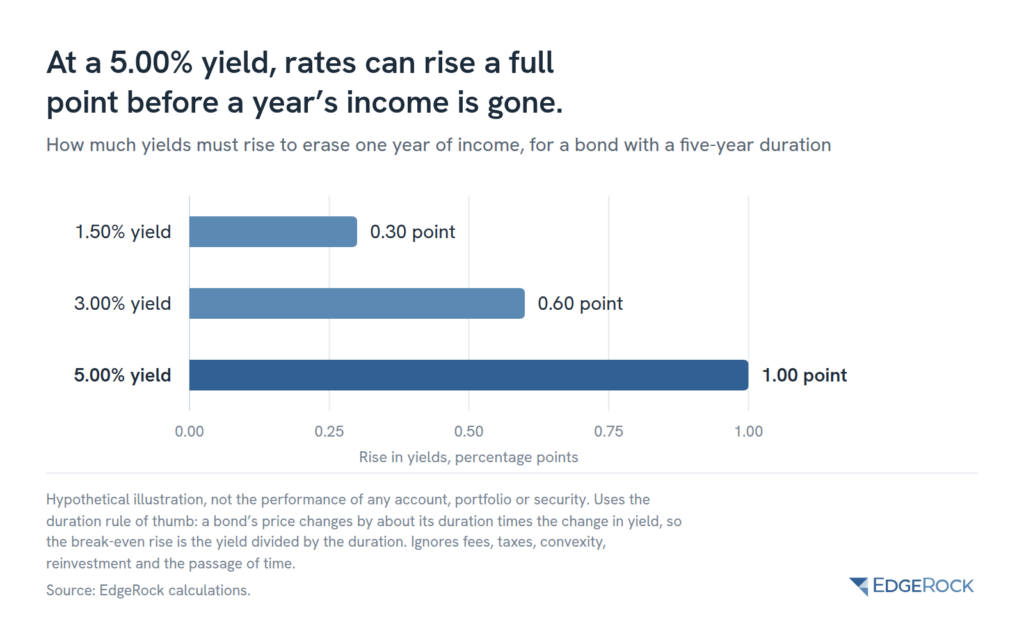
- At a 5% yield, a bond can absorb about three times as much of a rate rise as it could at 1.5%.
- Five-year Treasury bonds pay about 5.1%, with a fraction of a 30-year bond’s price risk.
- AI companies now account for nearly a quarter of investment-grade bond issuance by non-financial companies.
Latest from EdgeRock
Questions? Talk to our team.
Find out how truly custom, independent planning can impact your portfolio.
Start a Conversation
The 10-Year Treasury hit its highest yield since 2002. Is bond investing back on the table?
By Rob Foss
October 5, 2026 |
By Rob Foss
Rising rates hurt bondholders this quarter. They also left high-quality bonds paying around 5%, with a far bigger cushion against further increases.
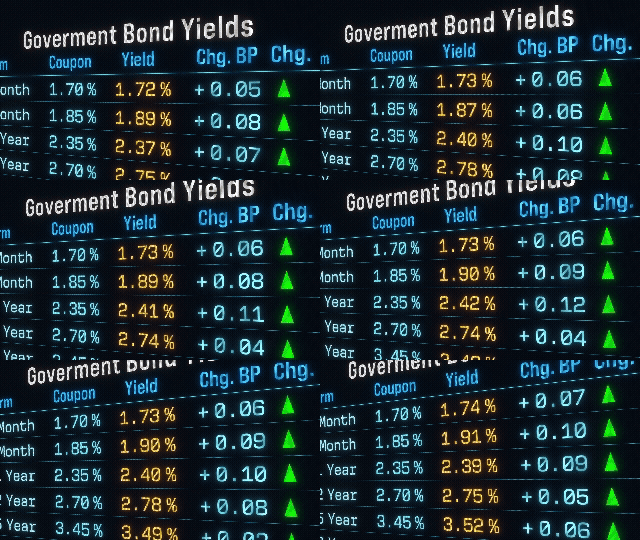
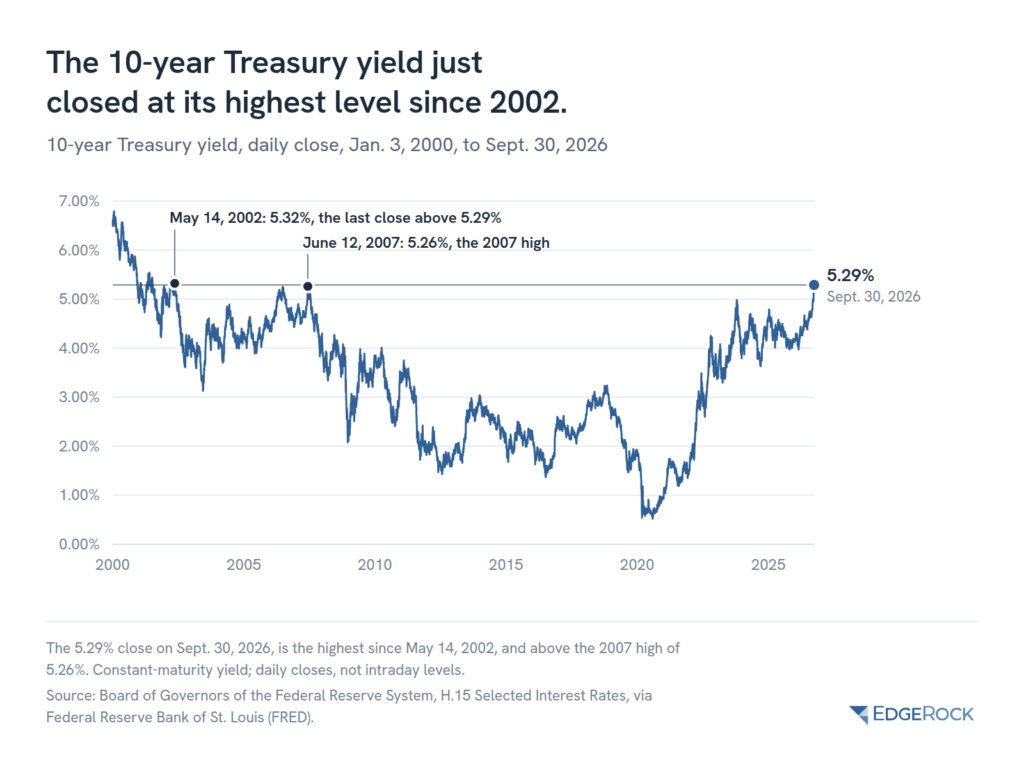
On October 1, the yield on the 10-year U.S. Treasury bond reached 5.34%, its highest level since 2002. Over the third quarter it climbed nearly 0.9 percentage point, its biggest quarterly rise this century. Freddie Mac’s weekly survey, released the same day, put the average 30-year mortgage rate at 7.28%.
Bond investors have felt every bit of it. The Bloomberg U.S. Aggregate Bond Index, the most widely followed measure of the U.S. bond market, has posted negative five-year returns during this stretch, a first in its roughly 50-year history.
The same move that caused the pain has made bonds a much better deal from here. High-quality bonds, meaning those issued by the U.S. government and financially strong companies, now pay around 5% a year. That level was rare for most of the past two decades. EdgeRock sees an opportunity in it for long-term investors, provided they stay careful about which bonds they own.
A quick refresher on why bond prices fall when rates rise
A bond is a loan. An investor lends money to the government or a company, collects interest along the way, and gets the money back at the end. A bond’s yield is the yearly return an investor would earn by buying it today and holding it until it pays back.
Prices and yields move like a seesaw. Suppose you own a bond paying 4%, and new bonds start paying 5%. Nobody will pay full price for your 4% bond when 5% is available elsewhere, so its price drops until it offers a similar return. That price drop is the loss bondholders saw this quarter.
Why borrowing costs jumped
The Fed raised rates, and inflation is still too high
On September 16, the Federal Reserve raised its benchmark interest rate by a quarter of a percentage point, to a range of 3.75% to 4%. It was the Fed’s first increase since 2023.
Fed officials expect inflation to finish the year far above their 2% goal. Their September projections put it at 3.7%, using the Fed’s preferred inflation gauge, known as PCE (short for personal consumption expenditures). They also raised their forecast for economic growth to 2.3%. The middle forecast among officials implies one more quarter-point increase before the year ends.
When the economy is strong and inflation is high, rates tend to stay higher for longer. Bond investors have adjusted to that.
Energy is the biggest single problem. Gasoline prices were up 27% from a year earlier in August, and oil has climbed again on renewed tension between the U.S. and Iran. Prices outside food and energy are rising more slowly, though still faster than the Fed wants. By the Fed’s preferred measure, those “core” prices rose 3.0% over the year through August.
The newest numbers arrived after the Fed’s projections. August PCE inflation came in cooler than economists expected at 3.4%, though part of that improvement came from a change in how the government measures some prices.
More bonds are up for sale
The federal government spends more than it collects in taxes and borrows the difference by selling Treasury bonds. Federal debt has now passed $40 trillion. Companies are borrowing heavily too. U.S. corporate bond sales totaled about $1.9 trillion through August, about 30% more than the same stretch last year.
When more borrowers compete for the same pool of investor money, they usually have to offer higher interest rates to attract buyers.
Investors want to be paid more for waiting
Lending money for 10 years is riskier than lending it for three months. Over a decade, inflation can surprise, the government can borrow more, and rates can swing in either direction. Investors expect extra pay for taking on that uncertainty. Economists call it the “term premium.” One Federal Reserve model puts it at about 1 percentage point on the 10-year Treasury, roughly a fifth of the bond’s total yield.
Inflation-protected Treasury bonds, known as TIPS, offer a clue about what investors are worried about. Their payments rise with inflation, so their yield shows what investors earn above inflation. At a September auction, 10-year TIPS paid 2.65% on top of inflation, the most at any such auction since 2008. Meanwhile, bond prices implied that investors expect inflation to average only about 2.3% a year over the next decade. The bond market does not appear to be bracing for a 1970s-style inflation spiral. Investors are asking for a bigger reward after inflation.
The next Fed meeting matters less than it seems
The Fed sets short-term rates directly. Long-term rates are set by buyers and sellers in the bond market, who weigh inflation, growth, government borrowing and the term premium. That is why the 10-year can keep rising even after the Fed stops raising rates.
It is also why EdgeRock isn’t putting much weight on whether the Fed moves again at its next meeting, October 27–28. Market odds of an October increase have swung back and forth within the past two weeks alone.
The AI building boom has reached the bond market
Some of the biggest borrowers this year are technology companies building data centers for artificial intelligence. Alphabet, Amazon, Meta, Microsoft and Oracle, often called “hyperscalers” because they run enormous networks of data centers, have issued about $220 billion of debt so far in 2026, according to Reuters. From 2020 through 2024, by Vanguard’s count, the same five companies borrowed about $35 billion a year on average.
The surge shows up across the market for investment-grade bonds, meaning bonds from companies that rating agencies consider very likely to repay. AI-related companies account for nearly one in four dollars of investment-grade borrowing by non-financial companies this year, according to PIMCO. In 2024 it was about one in 25.
Not every borrowed dollar goes straight into a data center. Large companies borrow for many reasons, and money is interchangeable once it’s in the bank. Still, the borrowing boom lines up with record spending on AI. Estimates cited by the Vanguard memo put total AI-related borrowing for the full year, counting chipmakers, data-center developers and utilities, at $300 billion to $570 billion.
For Treasury yields, AI borrowing is one pressure among several. Researchers at MSCI expect limits on future issuance to shrink its effect from here.
For corporate bond investors, it matters in two ways. First, the AI borrowers are absorbing the cost themselves. PIMCO found that bond buyers have demanded higher rates from the hyperscalers, while the extra interest other companies pay over Treasury bonds has not widened because of the AI supply. Second, much of this debt is very long-term, including 30-year bonds and even a 100-year bond. As that debt enters bond indexes, investors in ordinary index funds take on more sensitivity to interest rates without changing a thing they own.
Higher yields create different considerations
Rising rates hurt right away. The benefits arrive more slowly, as interest payments and maturing bonds get reinvested at the new, higher rates. A simple example shows how much the trade-off has improved.
Imagine $100,000 in a high-quality bond fund yielding 5%, close to what Treasury bonds maturing in five to seven years paid at the end of September. That’s about $5,000 a year in interest.
Say the fund has a duration of five years. Duration measures how much a bond’s price reacts when interest rates change. As a rule of thumb, a duration of five means a 1-percentage-point rise in rates knocks about 5% off the price.
So if rates rose a full point over the next year, the fund would lose about $5,000 in value and collect about $5,000 in interest. The investor would roughly break even. In this simplified example, before fees and other market shifts, rates would need to rise by more than a point within a year before the investor lost money.
Now run the same numbers at a 1.5% yield, closer to what bonds paid in 2020 and 2021. The interest is only $1,500 a year. A rise of just 0.3 percentage point would erase all of it. Today’s cushion against rising rates is more than three times as thick. Real results would differ, since bonds of different lengths and types react differently, but the basic arithmetic holds.
Looking out several years, the possibilities look like this. If rates stay near today’s levels, investors keep collecting around 5%. If inflation cools and the economy slows, rates could fall and bond prices would rise, adding gains on top of the income. If rates rise modestly, the higher income softens the loss. The hard case is a large, lasting jump in inflation and long-term rates, which would hurt long-term bonds most.
The case against bonds today
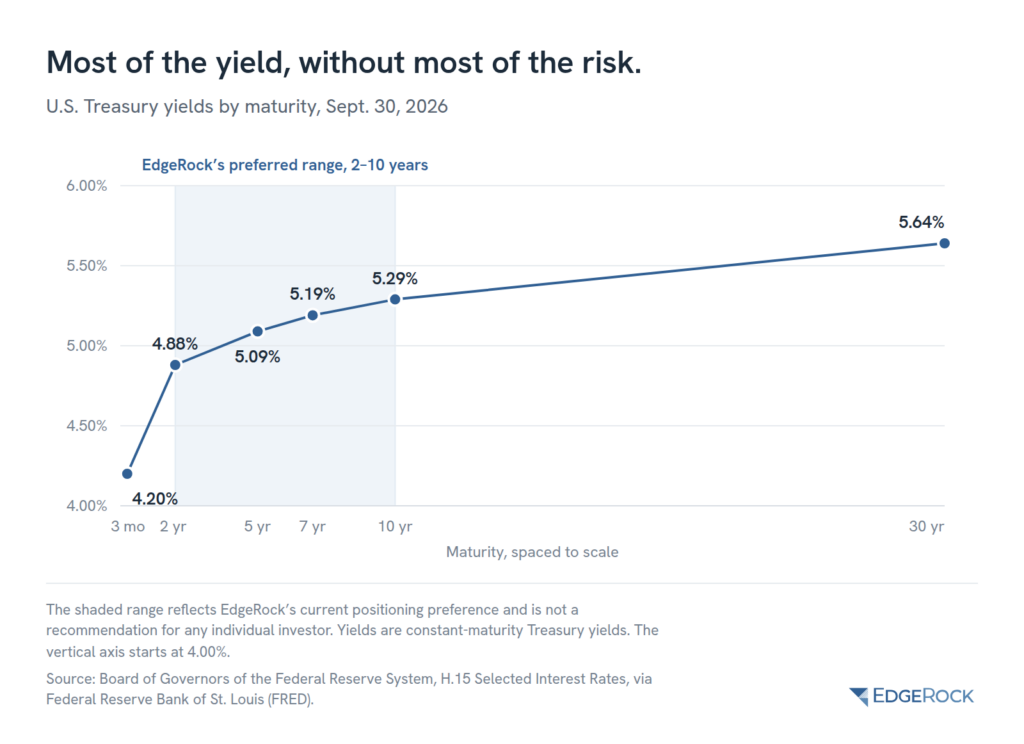
Cash pays well too. Three-month Treasury bills yielded about 4.2% at the end of September, and their prices barely move. A five-year Treasury paid only about 0.9 point more for five years of rate risk. Not a great trade-off, right? The answer is that cash rates follow the Fed and can drop quickly once the Fed starts cutting, while a five-year bond locks in today’s rate for five years. Cash protects against rising rates, and bonds protect against falling ones. Many portfolios hold some of each.
Rates could keep climbing. Nothing guarantees the selloff is over, especially for 30-year bonds, which react most to rate changes.
Bonds may not cushion stocks this time. High-quality bonds usually rise when stocks fall because of a slowing economy. When the problem is inflation, stocks and bonds can fall together. In 2022, both fell by double digits, with the Aggregate index losing about 13%. With inflation still the market’s top worry, investors shouldn’t count on bonds to offset every stock decline.
How EdgeRock is positioning bond portfolios
EdgeRock’s approach is to lock in higher yields without making a big bet on where long-term rates go next.
That starts with high-quality short- and intermediate-term bonds, roughly those maturing within two to ten years. At the end of September, Treasury bonds maturing in two to seven years paid about 4.9% to 5.2%. That’s somewhat less than 30-year bonds pay, with far smaller price swings.
EdgeRock is more cautious about long-term bonds. A 30-year Treasury pays about 5.6%, but by the same rule of thumb a 1-point rise in rates could cut its price by roughly 13% to 15%. Long-term bonds are the most exposed if government borrowing, inflation worries or the wave of long-dated corporate debt keep pushing long rates up.
We also don’t reach for extra yield from riskier borrowers. Companies pay a “credit spread,” extra interest above Treasury rates to compensate lenders for the risk of not being repaid.
Right now that extra pay is modest. Investment-grade corporate bonds yield, on average, less than 1 percentage point more than comparable Treasury bonds. If the economy weakens, spreads can widen quickly, and lower-quality bonds would fall in price.
Finally, EdgeRock is watching how the flood of long-term AI-related debt changes what’s inside bond index funds, since it can lengthen a fund’s duration without anyone noticing.
The adjustment may not be finished, particularly for the longest bonds, and more ups and downs wouldn’t be surprising. For an investor with a horizon of several years, a portfolio of high-quality bonds now starts with roughly 5% a year in income and a thicker cushion against rate increases than it had for most of the 2010s, which could make the asset more attractive for certain portfolios.
Past performance is not indicative of future results. The material above has been provided for informational purposes only and is not intended as legal, tax, or investment advice or a recommendation of any particular security or strategy. The investment strategy and themes discussed herein may be unsuitable for investors depending on their specific investment objectives and financial situation. Information obtained from third-party sources is believed to be reliable though its accuracy is not guaranteed, and EdgeRock Wealth Management, LLC makes no representation or warranty as to the accuracy or completeness of the information, which should not be used as the basis of any investment decision. Information contained on third party websites that EdgeRock Wealth Management, LLC may link to is not reviewed in their entirety for accuracy and EdgeRock Wealth Management, LLC assumes no liability for the information contained on these websites. Opinions expressed in this commentary reflect subjective judgments of the author based on conditions at the time of writing and are subject to change without notice. No part of this material may be reproduced in any form, or referred to in any other publication, without express written permission from EdgeRock Wealth Management, LLC.
Related Posts

Digging beneath the surface of the market
May 6, 2025Why bond alternatives matter in portfolios
January 15, 2026
Why investors shouldn’t hide from market corrections
April 7, 2025



About the Author
Related Posts
When Headlines Are Loud, Discipline Matters Most
March 3, 2026

Read more Insights