
October 6, 2026
Key Insights
- Markets historically recover from sharp drops
- Investors generally miss out on recoveries by trying to time the market
- News events should not distract from long-term investment goals
Latest from EdgeRock
Questions? Talk to our team.
Find out how truly custom, independent planning can impact your portfolio.
Start a Conversation
Why investors shouldn’t hide from market corrections
By Ryan Murphy
April 7, 2025 |
By Ryan Murphy
Nothing causes anxiety quite like a market downturn. But overreactions often distract us from the investment opportunities that come next.

Nothing causes anxiety quite like a market downturn.
Not that life doesn’t throw us other things to worry about. We endure health challenges, send children off to college, navigate relationships with friends and family—but there’s something uniquely anxiety-inducing about the stock market.
When the ticker symbols are green, we don’t have to think about our retirement savings all that much. But the bad stretches are nerve-wracking. Watching investment account trend downward for any stretch of time is concerning. It’s a threat to our natural territorial instincts. A jaguar stalking us in the woods—fight or flight.
All this fear and alarm belies the fact that, for professional investors, corrections often present important opportunities. Let’s talk about why.
History tells us markets recover
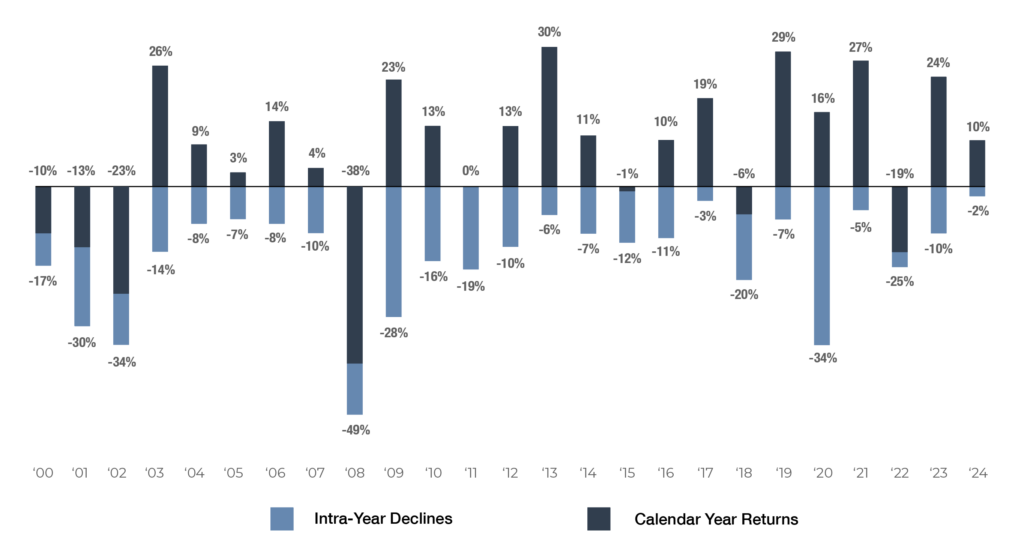
The image above depicts two figures: (1) the biggest market drop within the calendar year, and (2) where the market ended up overall on December 31.
Knowing that markets often produce positive returns, even after significant corrections, is crucial to know and understand in investing. It helps temper the recoil we feel when our net worth suddenly diminishes by 7–10%.
But history tells us what we do next often most influences our outcome.
For years, our advisors have listened to stories about how families navigated the wake of the Great Financial Crisis in 2008. It was a scary time for those nearing retirement age. Home values took a hit, and those with retirement savings endured a significant blow—there was nowhere to hide.
A refrain we heard a lot was, “I couldn’t trust the market anymore,” or, ” I just didn’t risk my retirement to another event like that.” These families often sought safety in cash and low-yield financial products. They were sold downside risk protection immediately following the largest collapse in stock market value in our lifetimes.
Essentially selling at the bottom and stuffing the money in a mattress.
Over the next five years, the S&P 500 would more than double, easily outpacing the pre-Great Recession growth trend. These risk-averse investors would miss out on a significant part of the recovery before warming up again to the stock market in the 2010s, beginning to reinvesting much too late.
Timing the market isn’t just hard. It’s nearly impossible.
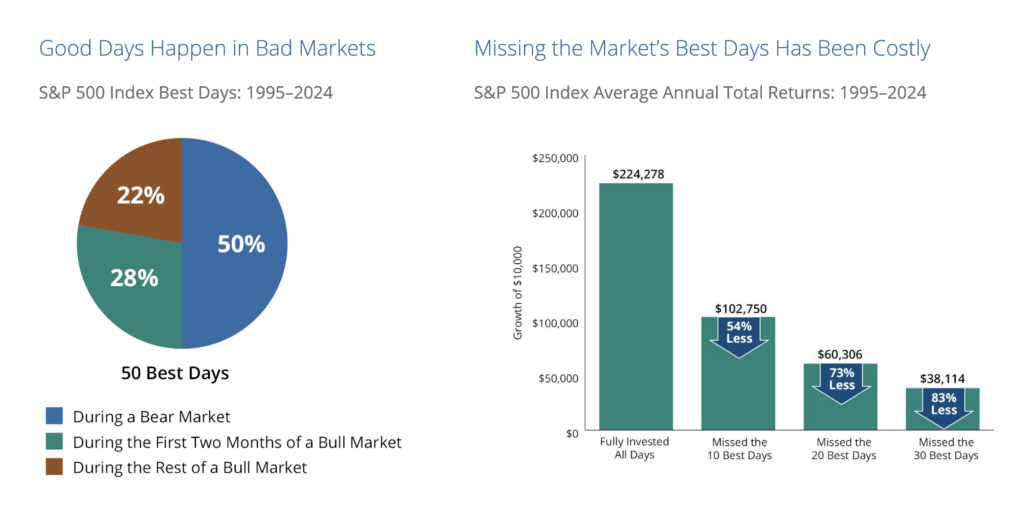
Getting out before the biggest drops, and back in before the recovery, requires great timing. Not just once, but twice. Most investors miss the upswing, which can significantly impact the long-term performance of a portfolio.
If you spend enough time in an EdgeRock office, you’ll hear this line a lot: “It’s not about timing the market, it’s about time in the market.”
And that’s because, historically, it’s proven to be the case. If an investor can navigate a correction, the benefits of a subsequent recovery can be extraordinary.
Fear isn’t our friend
Emotional decision-making fails us all the time. We know it’s best to “sleep on it,” but time isn’t always on our side and we’re forced to act the best way we know how.
But this kind of thinking puts us at a disadvantage as investors, especially compared to institutions, who tend to remain committed to long-term strategies in the face of headwinds.

When we look back, we see there is always a reason to hide when markets get choppy. There’s always something in the news. And if there’s nothing actively spooking the investor story, there’s always someone speculating about when it will collapse.
And yet? Investor returns remain undeterred.
Over time they march up and to the right.
Past performance is not indicative of future results. The material above has been provided for informational purposes only and is not intended as legal, tax, or investment advice or a recommendation of any particular security or strategy. The investment strategy and themes discussed herein may be unsuitable for investors depending on their specific investment objectives and financial situation. Information obtained from third-party sources is believed to be reliable though its accuracy is not guaranteed, and EdgeRock Wealth Management, LLC makes no representation or warranty as to the accuracy or completeness of the information, which should not be used as the basis of any investment decision. Information contained on third party websites that EdgeRock Wealth Management, LLC may link to is not reviewed in their entirety for accuracy and EdgeRock Wealth Management, LLC assumes no liability for the information contained on these websites. Opinions expressed in this commentary reflect subjective judgments of the author based on conditions at the time of writing and are subject to change without notice. No part of this material may be reproduced in any form, or referred to in any other publication, without express written permission from EdgeRock Wealth Management, LLC.
Related Posts

Private credit is under scrutiny. Is it warranted?
April 6, 2026
Estate planning mistakes business owners make
September 23, 20252025 mid-year market update
June 4, 2025The economy might need a new antibiotic
June 5, 2024




About the Author
As Director of Marketing, Ryan helps introduce EdgeRock to Colorado families and business owners. In a previous life, he reported on sports and culture for SBNation and The Denver Post.
Related Posts
Don’t fear the Buffett indicator
April 3, 2024Going Global: Inside EdgeRock’s latest model update
March 4, 2025


Read more Insights