
October 6, 2026
Key Insights
- Bad breadth is making it difficult to effectively diversify with the index alone.
- Passive ETFs and Mutual Funds distort market fundamentals in meaningful ways.
- Public fixed-income proxies feature similar distortions due increased weight in U.S. Treasuries.
- The S&P 500 will continue to offer low-cost exposure to great companies, but isn’t a one-stop portfolio solution.
Latest from EdgeRock
Questions? Talk to our team.
Find out how truly custom, independent planning can impact your portfolio.
Start a Conversation
The S&P 500 isn’t broken. But it’s increasingly a concentration risk.
By Rob Foss
May 19, 2026 |
By Rob Foss
Since 1957 we've relied on the S&P 500 to help us broadly invest in America's most profitable companies. Why is that getting harder?

Investors who buy the S&P 500 generally believe they are buying the American economy—five hundred large companies, broadly diversified, a decent proxy for U.S. capitalism. That used to be roughly true. It is not really true anymore.
Today, the ten largest companies in the index account for nearly 40% of its total weight, up from about 19% a decade ago. The Information Technology sector alone makes up roughly 32% of the index. Three companies—Alphabet, Amazon, and Meta—are expected to deliver about 70% of the index’s earnings growth in 2026. The S&P 500 is no longer a diversified slice of America. It is, increasingly, a concentrated bet on a small set of AI-related mega-caps. The index isn’t broken, but it also isn’t what most people think they bought.
A benchmark designed to represent America
The S&P 500 is the foundation for trillions of dollars in index funds, ETFs, derivatives, and institutional mandates. It is capitalization-weighted, which means each company’s share of the index is determined by the float-adjusted market value of its outstanding shares. Unlike the purely rules-based Russell 1000, the S&P 500 is curated by committee: Companies must be U.S.-domiciled, sufficiently large and liquid, and profitable on a GAAP basis over the most recent quarter and trailing four quarters.
The modern index launched in 1957 and quickly became the dominant benchmark for U.S. equities. Its rise accelerated when John Bogle launched the first retail index fund tracking the S&P 500 in 1976, an idea so radical at the time that critics nicknamed it “Bogle’s Folly.” The fund raised $11 million against a $150 million target.
Roughly fifty years later, indexing is the default way most Americans own equities.
How the index quietly stopped being broadly diversified
Concentration in the S&P 500 has reached levels that exceed even the dot-com peak. At the start of 2000, the top 10 names accounted for roughly 23-25% of the index. Today they account for closer to 40%. The five largest companies alone represent the highest concentration the index has seen in half a century.
This is worth pausing on. The index that most Americans use as their core equity exposure is more top-heavy now than it was in March 2000, when the dot-com bubble was at its most fevered.
There are two important caveats. First, today’s megacaps are real businesses with real earnings. The forward P/E on today’s top 10 sits around 26x—well above the broader market but nowhere near the roughly 66x multiple the top 10 carried at the dot-com peak. This moment isn’t 1999.
Second, market concentration has happened before—railroads in the late 19th century, industrial conglomerates in the postwar era, the Nifty Fifty in the early 1970s, technology and telecom in the late 1990s. The U.S. equity market has periodically been dominated by a narrow group of leaders, then re-broadened. There is no rule that says today’s leaders and is likely to be tomorrow’s.
What is genuinely different this time is the plumbing.
Why passive flows reinforce the concentration
In 1976, when Bogle launched his fund, passive investing was an academic curiosity. Today, passive vehicles own roughly half of all U.S. equity fund assets—and as of late 2024, passive mutual funds and ETFs surpassed active ones in total AUM for the first time. By the end of 2025, passive assets stood at about $19.1 trillion versus $16.2 trillion for active. The rotation isn’t slowing.
Capitalization-weighted indexing means a passive dollar invested in the S&P 500 buys more of whatever is biggest, regardless of price or fundamentals. When the largest companies’ share prices rise, their index weight rises with them. Higher weight attracts more passive inflows. More inflows push prices higher still. The mechanism is mechanical, not analytical.
Critics of modern market structure call this a reflexive feedback loop. Flows influence prices. Prices influence index weights. Index weights attract more flows. Active managers—the ones doing actual price discovery—become a shrinking share of the marginal trades that set valuations. And once Vanguard and BlackRock manage assets in the $10-15 trillion range, the size of their flows becomes its own market force.
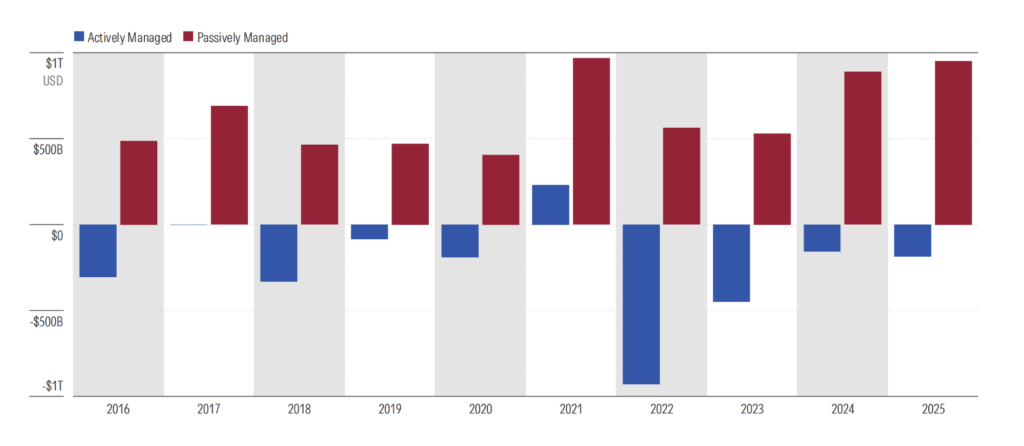
Reasonable people disagree about how dominant this dynamic is. Defenders of cap-weighted indexing—including AQR’s Cliff Asness, who has argued that markets remain “not perfectly efficient” but still meaningfully so—point out that active managers continue to set marginal prices and that the magnitude of passive’s distortive effect is genuinely contested. But it is hard to look at the trajectory of mega-cap index weights over the past decade and conclude that flow mechanics have nothing to do with it.
New rules could let the next round of mega-IPOs in faster
In late April 2026, S&P Dow Jones Indices announced a consultation on changes to its inclusion methodology. The two big proposals: reduce the time a company must be public from 12 months to six months before becoming eligible, and waive the profitability requirement for the largest mega-cap candidates.
The timing isn’t an accident. SpaceX, OpenAI, and Anthropic are all reportedly preparing to go public, any of them potentially worth hundreds of billions of dollars. Under current rules, none would be eligible for the S&P 500 for at least a year. Under the proposed rules, they could be added almost immediately.
If those companies are added at scale, the index’s concentration in AI-related and digital-infrastructure businesses will increase further—and most passive investors will own that increase by default, the same way they own the current concentration: without ever choosing it.
The same story has played out in bonds
This isn’t the first time a foundational benchmark has quietly become something other than what investors assumed. The Bloomberg U.S. Aggregate Bond Index was once a balanced fixed-income proxy. Treasury exposure in the index has risen from about 24% in 2004 to roughly 45% today, driven by the Treasury’s expanding issuance to fund federal deficits. Duration has extended from a long-term average of about five years to nearly six, making the index more sensitive to interest-rate moves than it used to be.
Investors who hold the AGG as their “diversifying” fixed-income allocation are, increasingly, holding a duration-extended bet on U.S. government debt. The benchmark didn’t fail. It evolved. The risk is that perceptions of what it offers haven’t kept up.
The S&P 500 is on a similar trajectory in a different asset class.
What this means for portfolio construction
None of this means the S&P 500 is a bad investment. It continues to deliver low-cost exposure to many of the most profitable, most innovative businesses in the world. EdgeRock holds it in client portfolios and expects to continue doing so.
What it does mean is that the word “diversified” no longer means what it used to mean when applied to a market-cap-weighted U.S. equity index. A portfolio that consists primarily of the S&P 500 is not, by any honest accounting, broadly diversified across the U.S. economy—let alone the global one. It is concentrated in a small number of mega-cap technology and AI-related businesses, with all the correlated drawdown risk that implies if sentiment, regulation, or AI capex expectations turn.
The implication for investors isn’t to sell the S&P 500. It is to stop relying on it alone to do diversification’s job. EdgeRock’s view is that real diversification in 2026 increasingly requires deliberate exposure beyond cap-weighted public equity: international developed and emerging markets, small- and mid-cap companies, real assets, private equity and private credit, and alternative income strategies whose return drivers don’t move in lockstep with U.S. mega-cap tech.
The most important risk in markets is rarely the one investors are watching. It’s the one they assume they’ve already addressed.
Past performance is not indicative of future results. The material above has been provided for informational purposes only and is not intended as legal, tax, or investment advice or a recommendation of any particular security or strategy. The investment strategy and themes discussed herein may be unsuitable for investors depending on their specific investment objectives and financial situation. Information obtained from third-party sources is believed to be reliable though its accuracy is not guaranteed, and EdgeRock Wealth Management, LLC makes no representation or warranty as to the accuracy or completeness of the information, which should not be used as the basis of any investment decision. Information contained on third party websites that EdgeRock Wealth Management, LLC may link to is not reviewed in their entirety for accuracy and EdgeRock Wealth Management, LLC assumes no liability for the information contained on these websites. Opinions expressed in this commentary reflect subjective judgments of the author based on conditions at the time of writing and are subject to change without notice. No part of this material may be reproduced in any form, or referred to in any other publication, without express written permission from EdgeRock Wealth Management, LLC.
Related Posts

EdgeRock Outlook 2025
December 3, 2024Understanding Roth Contributions vs. Roth Conversions
November 25, 2024The economy might need a new antibiotic
June 5, 2024




About the Author
Related Posts

One Year In: The global thesis in review
May 5, 2026

Read more Insights