
October 6, 2026
Key Insights
- Chip-stock gains driven mostly by profit growth
- Today’s AI leaders far cheaper than the 2000 tech leaders
- Cloud contracts heavily tied to OpenAI
- Rising borrowing to fund the AI build-out
- Two of EdgeRock’s three warning signs now moving
Latest from EdgeRock
Questions? Talk to our team.
Find out how truly custom, independent planning can impact your portfolio.
Start a Conversation
Is AI in a Bubble? What the Profits, the Contracts and the Debt Say
By Rob Foss
November 4, 2026 |
By Rob Foss
As Anthropic prepares to debut a massive IPO, investors are questioning how much room the AI trade has to grow. We dive into what's below the stock price.

On October 28, Alphabet, the parent company of Google, reported that its cloud computing business had doubled its sales from a year earlier. Cloud computing means renting out computers in giant data centers over the internet, and companies are lining up to rent Google’s to run artificial intelligence. The next day, Alphabet’s Class A shares fell 12.6%.
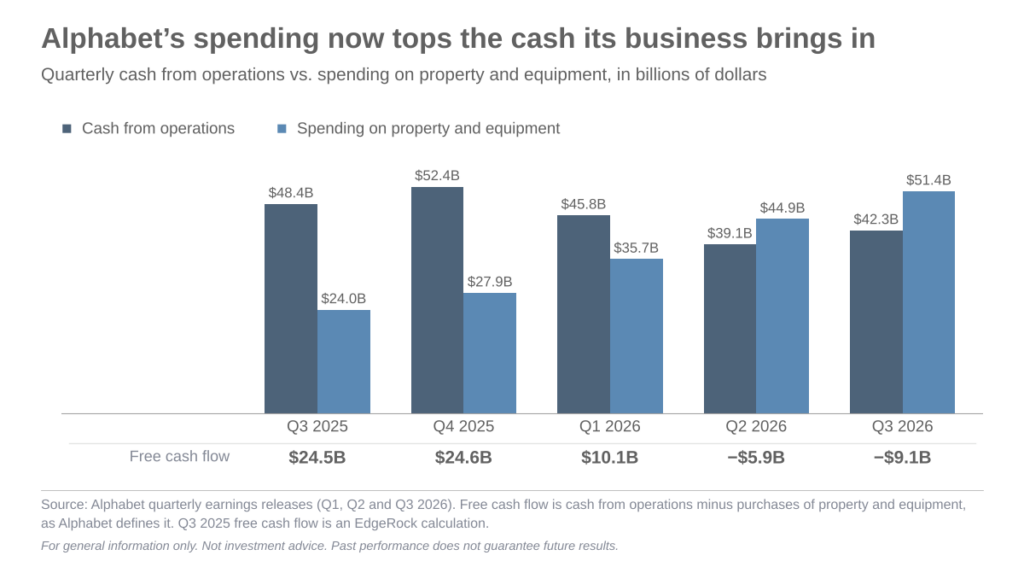
Investors focused on the bill. In the three months through September, Alphabet spent $51.4 billion on data centers and equipment, more than twice what it spent a year earlier. That was more cash than its business brought in. In the same quarter, it borrowed about $29 billion and raised $12.4 billion by selling new shares, according to its earnings release.
That one day holds the whole AI debate. Demand for AI is real and growing fast. What nobody knows yet is whether the hundreds of billions of dollars being spent to meet that demand will earn a decent return, and how much of that success investors have already paid for.
EdgeRock’s view is that AI stocks today are not in a bubble like the one that burst in 2000. The leading companies earn large, real profits, and most of the rise in their stock prices has come from those profits growing. But some of the warning signs EdgeRock watches have started to move, and they deserve a close look.
What a bubble actually is
A bubble forms when prices drift far away from what an asset can actually earn. People buy because they expect the price to keep rising, and they stop asking how much cash the asset will produce.
Bubbles often grow around real breakthroughs. The internet changed the world, just as its fans promised in the late 1990s. Many investors who bought internet stocks in 1999 still lost most of their money, because they paid far too much for them. The technology succeeded while many of the stocks failed.
That makes price the question to ask about AI. Few people still doubt that AI will matter. Investors need to know whether today’s prices make sense given what these companies are likely to earn.
Chip stocks rose mostly because chip profits rose
To judge whether a stock is expensive, investors use the price-to-earnings ratio, or P/E. It tells you how many dollars you pay for each $1 of a company’s yearly profit. Picture a lemonade stand that earns $1,000 a year. If someone buys it for $20,000, they paid 20 times its earnings. When the profit in that math is analysts’ estimate for the coming year, it’s called a forward P/E.
In a classic bubble, prices climb because investors agree to pay more and more for the same profit, so the P/E balloons.
That hasn’t happened to the companies that make AI chips. The PHLX Semiconductor Index, which tracks 30 large chip companies, traded at about 20 times forward earnings as of August 24, according to research from BlackRock, an asset manager that runs AI-focused funds. That’s a little below the index’s five-year average of about 22.
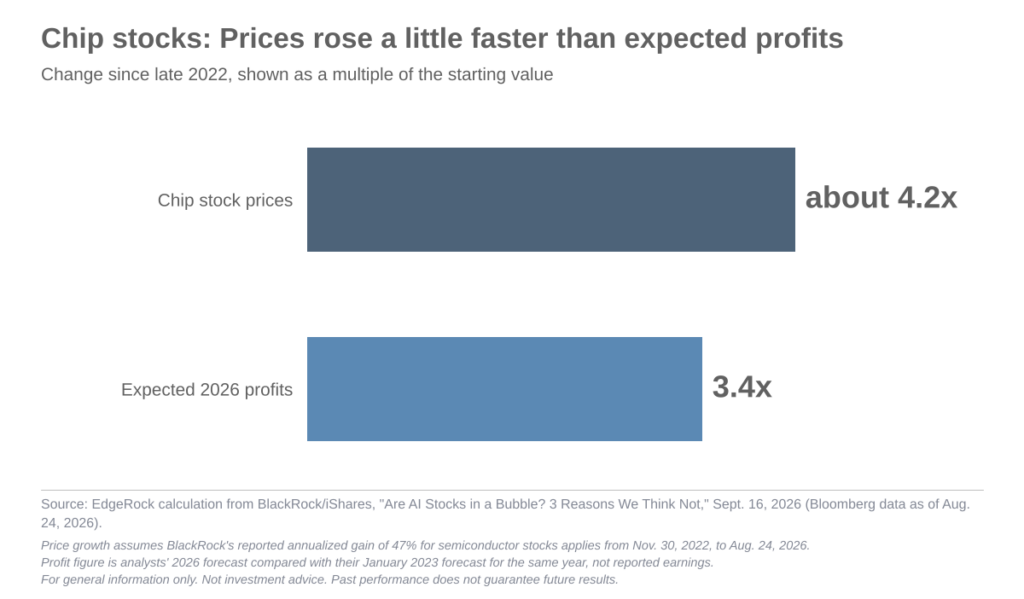
The low ratio comes after a huge run. Chip stocks gained about 47% a year from late November 2022, BlackRock found. By EdgeRock’s math, $10,000 growing at that pace through late August would have become roughly $42,000.
Profits explain most of it. Analysts now expect chip companies to earn 3.4 times as much in 2026 as they predicted at the start of 2023, according to the same BlackRock research. Prices rose faster than that, so the stocks did get pricier: By EdgeRock’s estimate, investors now pay roughly a fifth to a quarter more for each dollar of expected profit than they did at the start of 2023. Most of the climb, though, was paid for by earnings.
That doesn’t make chip stocks cheap, and it doesn’t promise that profits will keep growing. (The section below on the case against explains why that matters.) It does weaken the argument that the run was driven mainly by speculation.
The AI spending is showing up as real sales and profits
Nvidia designs the chips that power most AI systems. In the three months ended July 26, its revenue was $96.2 billion, up 106% from a year earlier, the company reported. Its operating income, the profit from its core business before interest and taxes, rose 124% to $63.7 billion. Sales to data centers, the giant warehouses of computers that run AI, reached $89 billion.
Taiwan Semiconductor Manufacturing Company, or TSMC, builds the most advanced chips for many of the world’s largest technology companies. In the three months through September, its revenue rose about 51% and its profit rose about 69% from a year earlier, measured in Taiwan dollars, TSMC reported. In U.S. dollars, revenue rose about 41%.
The companies buying all this equipment are starting to earn money from it, too. The biggest buyers are the hyperscalers, the handful of tech giants that run cloud computing services at enormous scale and rent computing power to other businesses. On October 28, Microsoft said revenue from Azure, its cloud service, grew 48%. Alphabet said Google Cloud’s revenue rose 103% to $30.7 billion, with $11.1 billion in operating income, according to its release.
That is a sharp contrast with the dot-com era, when many companies had high stock prices, little revenue and no profits. Today’s leading AI companies run established businesses with paying customers.
These results have a limit. Nvidia’s and TSMC’s profits show how much money is being spent on AI. They don’t prove that the spending will pay off for the companies doing the buying. That is the question that matters most from here.
Customers have signed contracts for years of cloud services
Many investment busts follow the same pattern: Companies build for demand that never shows up. In the late 1990s, telecom companies laid so much fiber-optic cable that by 2002 only about 2% to 5% of it was in use, according to the FDIC.
Much of today’s AI building is backed by signed contracts. A company’s backlog is the work customers have committed to buy but haven’t received yet. BlackRock noted that the combined cloud backlog of Amazon, Alphabet, Microsoft and Oracle nearly tripled in a year, to about $2.3 trillion.
There was also no sign of too much capacity as of late summer. When there’s a glut, old equipment gets cheap. Instead, the hourly price to rent Nvidia’s H100 chips, which BlackRock describes as roughly three years old, kept rising over the 12 months through August, according to data BlackRock cited.
A backlog has limits, though. It isn’t profit, and part of it covers ordinary cloud services that have nothing to do with AI. It also stretches over many years. Microsoft expects to deliver only about 30% of the backlog from its business customers in the next 12 months, Yahoo Finance reported.
And a big share of it comes from one customer. OpenAI, the company behind ChatGPT, accounted for about 45% of that Microsoft backlog in January, TechRadar reported, and for more than half of Oracle’s as of February, according to The Motley Fool. OpenAI hasn’t turned a profit. A contract is only as good as the customer’s ability to pay.
Today’s tech giants cost far less than the leaders of 2000
The most direct comparison with 2000 is price. At the peak of the dot-com bubble, the biggest tech companies (Microsoft, Cisco, Intel and Oracle) traded at nearly 70 times the profits analysts expected two years ahead, according to BlackRock, citing Goldman Sachs Research. Today’s biggest AI spenders (Microsoft, Alphabet, Amazon and Meta) traded at about 18 times on the same measure as of August 24, based on Bloomberg data.
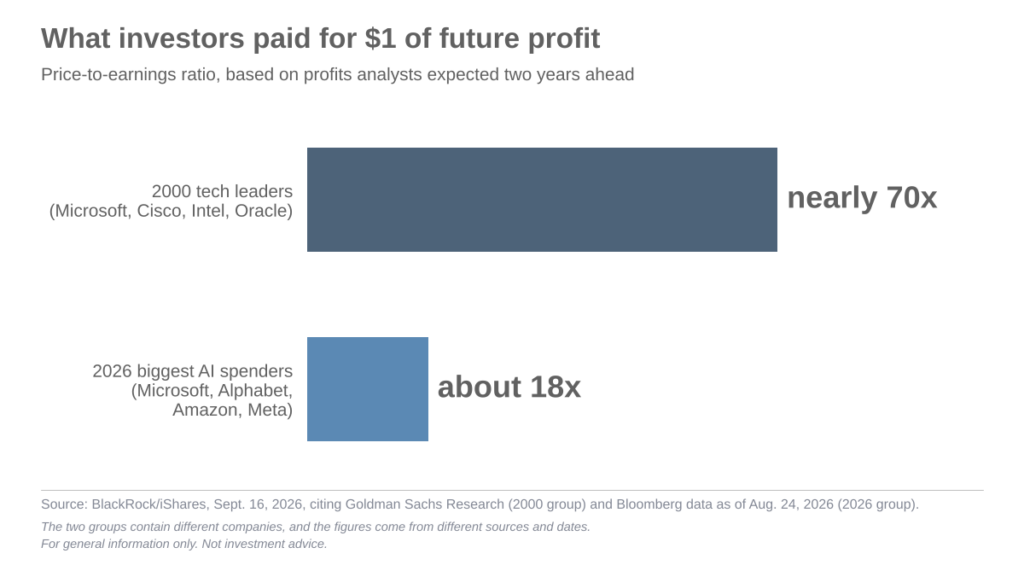
The comparison isn’t perfect. The groups differ, only Microsoft appears in both, and the two figures come from different sources. The gap is still large.
Cisco shows what a high price can do even to a strong company. In March 2000, the maker of internet networking equipment was briefly the most valuable company in the world. It had a real business and real profits. Its stock lost nearly 90% of its value by late 2002, and it didn’t close above its 2000 high until December 2025, more than 25 years later, Sherwood News reported.
Today’s largest tech companies also have something many dot-com companies lacked: established businesses that throw off cash to pay for new building. That still holds, but Alphabet’s latest quarter shows the strain. When spending outruns the cash a business brings in, even the strongest companies borrow.
The trend is clear across the group. A Reuters analysis in July looked at Microsoft, Alphabet, Amazon, Meta and Oracle. It projected that from 2025 to 2027, their yearly spending on new buildings and equipment will grow by about $534 billion, while the yearly cash their businesses bring in grows by only about $340 billion, Reuters reported. That’s about $1.57 of new spending for every new $1 of cash.
What’s left after that spending is called free cash flow: the money a company has once it pays to run its business and to invest in new equipment. Microsoft still produced $18.6 billion of it last quarter, though that was down 27% from a year earlier, by The Motley Fool’s calculation. Alphabet’s was negative.
The risk of paying too much is higher for smaller companies and for those whose fortunes depend almost entirely on AI.
The case against, which deserves a hearing
The strongest argument against EdgeRock’s view is about the “E” in P/E.
Chip companies’ profits rise and fall with their customers’ spending. When customers are building, chipmakers’ profits soar. When customers pause, those profits can drop fast. In 2001, worldwide chip sales were forecast to fall 32%, according to World Semiconductor Trade Statistics. JDS Uniphase, which made parts for fiber-optic networks, saw its revenue grow 16-fold in eight quarters during the telecom boom, then fall 80% over the next eight, Reuters Breakingviews noted.
That pattern matters because a P/E looks lowest at the top of a cycle, when profits are biggest. Take a chip stock priced at $100 with $5 of expected profit per share. That’s a P/E of 20. If profit drops by a third, to about $3.33, the same $100 price becomes a P/E of 30. The stock price didn’t change. The profit shrank. Today’s ratio of 20 is only reassuring if today’s profits last.
The second argument is about the buyers’ math. Gartner, a technology research firm, estimates that AI companies will spend nearly $1 trillion on AI infrastructure this year and $6 trillion more from 2027 through 2030, CRN Asia reported. To cover those costs, pay for the money they borrow and earn a 12% return, the owners of AI data centers would need about $8.5 trillion in revenue through 2030. Gartner forecasts no more than $3.6 trillion.
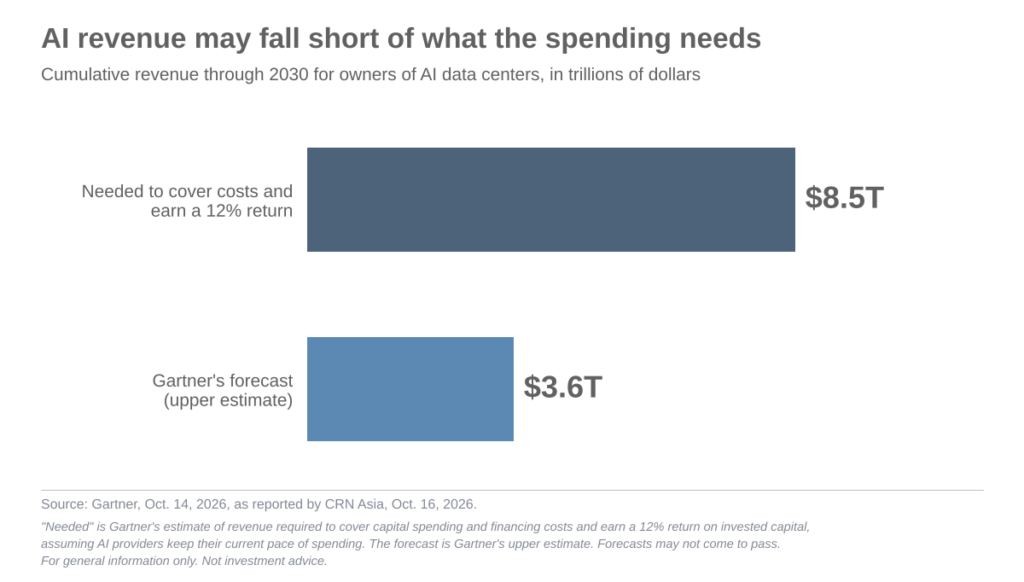
Forecasts about new technology are often wrong, in both directions. But Gartner’s estimate puts a number on a real risk: AI could transform the economy without the companies building it earning an attractive return on what they spent.
The third argument is about price competition. As AI models improve and rivals catch up, the price of AI services is likely to fall. That’s good for customers. It’s hard on the companies selling AI, because they keep less profit from each dollar of sales.
Where the strain is showing: debt and the “neoclouds”
The weakest links so far are the neoclouds. These are newer companies that buy AI chips, often with borrowed money, and rent the computing power to AI developers. Unlike Microsoft or Alphabet, most have no other business to fall back on if prices or demand slip.
CoreWeave is one of the largest. It has never turned a profit and carries about $50 billion of debt by the count of data firm LSEG, Reuters reported on October 15. Part of that debt is in bonds, which are loans that investors buy and can trade. CoreWeave’s bonds due in 2031 have yielded about 16%, according to Reuters. That yield is the yearly return investors demand to lend to the company, and a number that high signals they see a real chance of not being paid back. CoreWeave’s stock market value has fallen from close to $90 billion at its peak to about $31 billion, International Finance reported. Its chief executive told employees in a memo seen by Reuters that the company’s backlog, $104.2 billion at the end of June, more than covers its debt obligations.
Gartner predicts that more than 80% of neocloud providers will cease independent operations by 2030, meaning they’ll either fail or be bought.
The chipmakers are also helping their own customers pay. Nvidia has put up to $164.5 billion of guarantees and commitments behind data centers that run its chips, Forbes reported, citing The Information and Nvidia’s filings. The largest piece is a guarantee of up to $105 billion on the lease for an OpenAI data center campus in Ohio. Nvidia has also agreed to buy any CoreWeave computing capacity that goes unrented through April 2032. Most of these promises cost Nvidia nothing unless something goes wrong.
Investors have seen this arrangement before. In 2000, telecom equipment maker Lucent committed $5.7 billion in credit to its customers, including $2 billion to Winstar, eWeek reported. Winstar went bankrupt. Lending to customers helps sales in good times. In bad times, the supplier loses the sales and takes the losses on the loans.
Trouble among some of these companies wouldn’t by itself mean AI demand had collapsed. It could simply mean some of them borrowed too much to grow too fast. The telecom boom of the 1990s helped build the networks the internet still runs on, and many of the investors who paid for it lost money anyway.
The warning signs EdgeRock is watching
EdgeRock is tracking three signals. A lasting turn for the worse in them would lead EdgeRock to rethink its view.
- Spending that grows faster than profits. Now moving. Alphabet’s free cash flow has been negative for two quarters in a row, according to its results, and Reuters projects that spending at the five biggest spenders will keep growing faster than their cash through 2027.
- More computing power than customers need. Not yet. Rental prices for older Nvidia chips were still rising through late August. That month, a Bank of America analyst said computing “remains mostly supply constrained,” meaning customers want more than the industry can supply, according to Yahoo Finance.
- Leaning on debt or on loans and guarantees from suppliers. Now moving. Alphabet’s long-term debt rose from $46.5 billion at the end of 2025 to $125.1 billion at the end of September, its results show. CoreWeave’s borrowing costs have jumped, and Nvidia has put up to $164.5 billion of guarantees and commitments behind its customers’ data centers.
Two of the three are flashing yellow, but none have turned red.
What this means for a diversified portfolio
A falling stock price doesn’t always mean a bubble has burst. Even very profitable companies can drop sharply when investors lower their hopes for growth or decide to pay less for each dollar of profit. A drop of 10% or more from a recent high is usually called a correction. Corrections are uncomfortable, but they don’t necessarily mean the reasons for owning a company have changed.
The effects also reach beyond AI stocks. The biggest tech companies make up a large share of the major stock indexes. AI spending also drives business for utilities, industrial companies and lenders. So a portfolio with little direct exposure to AI stocks can still feel a shift in how investors value AI.
For now, EdgeRock’s view is that, for long-term investors with diversified portfolios (money spread across many kinds of investments), the evidence does not call for abandoning the companies building AI. It does call for discipline about the prices paid, the strength of each business and how widely a portfolio is spread. The right mix depends on each investor’s goals and circumstances. EdgeRock expects more ups and downs as investors weigh AI’s enormous promise against the cost of building it, the competition and the challenge of turning it into profit.
The answers will show up in three numbers the biggest spenders report every quarter: how much free cash flow they produce, how much they borrow, and how much of their backlog depends on a single customer.
Past performance is not indicative of future results. The material above has been provided for informational purposes only and is not intended as legal, tax, or investment advice or a recommendation of any particular security or strategy. The investment strategy and themes discussed herein may be unsuitable for investors depending on their specific investment objectives and financial situation. Information obtained from third-party sources is believed to be reliable though its accuracy is not guaranteed, and EdgeRock Wealth Management, LLC makes no representation or warranty as to the accuracy or completeness of the information, which should not be used as the basis of any investment decision. Information contained on third party websites that EdgeRock Wealth Management, LLC may link to is not reviewed in their entirety for accuracy and EdgeRock Wealth Management, LLC assumes no liability for the information contained on these websites. Opinions expressed in this commentary reflect subjective judgments of the author based on conditions at the time of writing and are subject to change without notice. No part of this material may be reproduced in any form, or referred to in any other publication, without express written permission from EdgeRock Wealth Management, LLC.
Related Posts

CPI vs. PCE: Different rulers, same objective
August 21, 2024
The value of integrated financial planning
May 7, 2026Digging beneath the surface of the market
May 6, 2025



About the Author
Related Posts

Risk Management Doesn’t Have to Mean Conservative
September 1, 2026


Read more Insights