
January 15, 2026
Key Insights
- Military conflicts have not traditionally been a reason to avoid markets
- A portfolio should be designed with geopolitical shocks in mind
- History suggests disciplined investors are likely to fare better than those who react to headlines
Latest from EdgeRock
When Headlines Are Loud, Discipline Matters Most
By Ryan Murphy
March 3, 2026 |
By Ryan Murphy
Geopolitical conflict is never just a headline.

Images coming out of Iran are serious and unsettling. War carries real human consequences, and periods like this can feel heavy—especially when markets begin reacting in real time. Energy prices move. News alerts multiply. Commentary grows louder by the hour.
It’s natural to wonder: What does this mean for markets and my portfolio?
Before we respond to the moment, it helps to zoom out.
Markets Have Lived Through This Before
The chart below tracks the S&P 500 going back nearly a century, marked with major military conflicts along the way.
From World War II to the Korean War…
From Vietnam to the Gulf War…
From 9/11 to Russia–Ukraine…
Markets have experienced shock, volatility, and uncertainty many times over.
And yet, over long stretches of time, the broader trend has been one of resilience and growth.
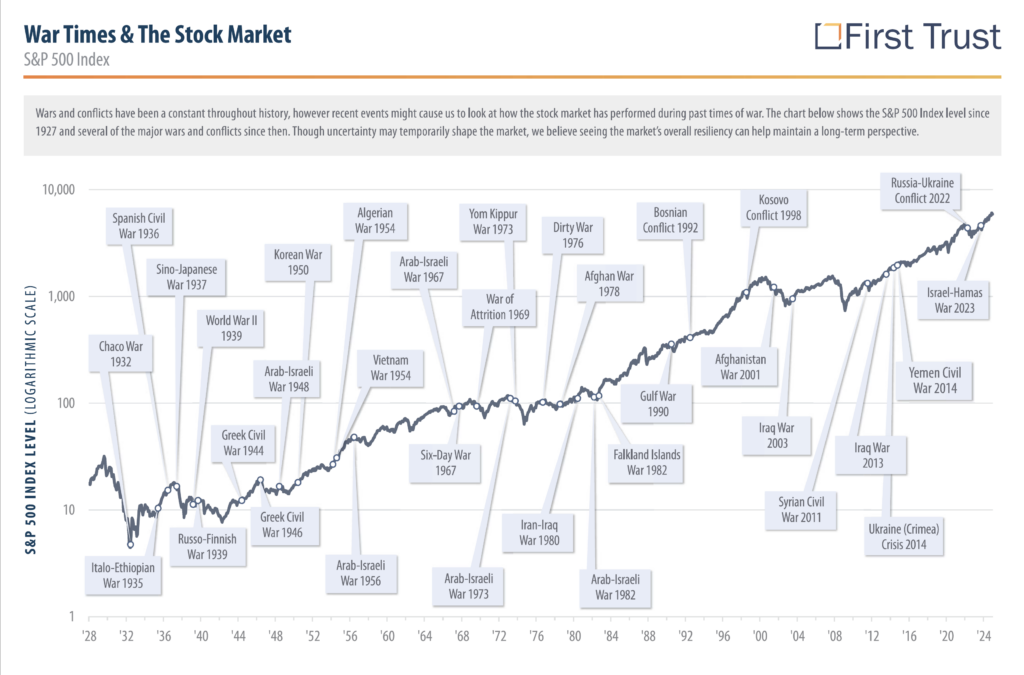
That doesn’t mean markets don’t react. They do. Energy prices can spike. Risk sentiment can shift. Certain sectors may move sharply for a period.
But historically, geopolitical events—while emotionally significant—have rarely altered the long-term trajectory of diversified equity and fixed income markets. Most conflicts tend to create short-term volatility rather than structural economic impairment.
The danger for investors is not volatility itself.
It’s making permanent portfolio decisions based on temporary events.
How We Are Approaching the Current Iran Conflict
Rather than reacting to headlines, our role is to interpret them within a broader framework.
Below is the statement our CIO Rob Foss issued this week:
“We continue to monitor developments in the Iran conflict closely and evaluate potential economic and market implications as the situation evolves. While geopolitical tensions have triggered volatility in energy prices and influenced risk sentiment in some asset classes, broader equity and fixed-income markets have, to date, demonstrated resilience and are holding up without evidence of a systemic disruption.
Importantly, our disciplined approach to portfolio construction is grounded in long-standing historical data and statistical frameworks that explicitly incorporate past episodes of geopolitical conflict and market stress; these historical inputs help ensure that allocations are informed by how markets have responded across varied environments, including periods of heightened conflict and uncertainty. Should conditions change materially, we will communicate updates and any relevant adjustments to firm outlook and strategy.“
In simpler terms:
- We are watching the situation closely.
- We are evaluating energy markets, credit spreads, and liquidity conditions.
- We are not seeing evidence of systemic financial stress.
- Our portfolios are built with the assumption that geopolitical shocks will occur from time to time.
This last point is important.
Conflict is not an anomaly in market history—it is part of market history. Our asset allocation models, risk controls, and scenario analysis explicitly account for periods of heightened uncertainty. We do not build portfolios assuming calm environments. We build them assuming the opposite.
If the economic backdrop changes materially, we will adjust thoughtfully—not reactively.
Staying Focused on What Matters
Periods like this test investor discipline.
The news cycle operates minute by minute. Investment strategy operates year by year.
History suggests that investors who remain grounded in a long-term plan tend to fare better than those who attempt to reposition portfolios around geopolitical headlines. The short-term path may be uneven. The long-term direction has historically rewarded patience.
We will continue to monitor developments and communicate transparently if conditions warrant a change in outlook or positioning.
For now, the appropriate response is the same one that has served investors well across decades of uncertainty:
Stay diversified.
Stay disciplined.
Stay focused on the long term.
Related Posts

Estate planning mistakes business owners make
September 23, 2025The lifetime value of Roth conversions
August 26, 2024
The Sahm Rule trigger might not indicate recession
August 6, 2024




About the Author
As Director of Marketing, Ryan helps introduce EdgeRock to Colorado families and business owners. In a previous life, he reported on sports and culture for SBNation and The Denver Post.
Related Posts
Don’t fear the Buffett indicator
April 3, 2024Going Global: Inside EdgeRock’s latest model update
March 4, 2025

Read more Insights